The Vision Tax: What Fogged Goggles Actually Cost You Over a Race Day
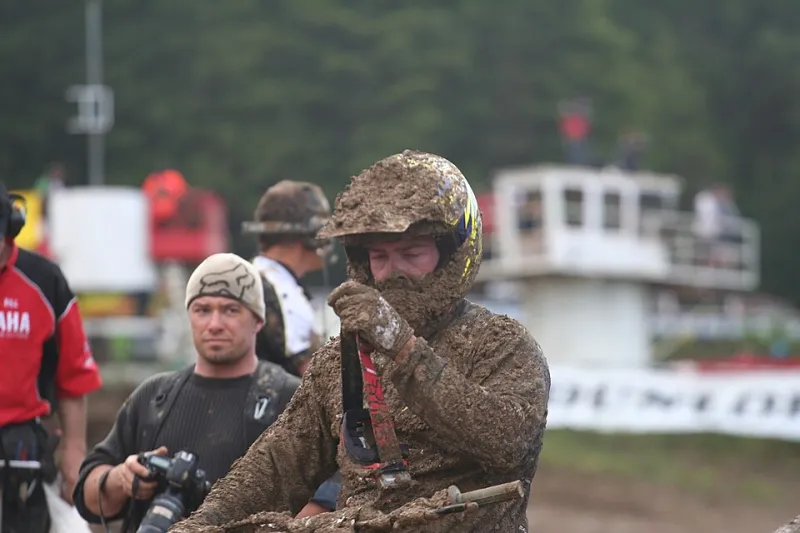
Photo: Moosealope, CC BY 2.0, via Wikimedia Commons
You rarely lose a moto in one big, cinematic moment. You lose it in a hundred small blinks — the half-second where a roost-covered lens turns a rut into a guess, the fogged-up panic as the gate drops, the lap where you back off because you genuinely can't see where the braking bumps start.
Vision is the cheapest performance part on the bike. Most club riders spend hundreds on a pipe and then squint through a scratched lens for four laps. Time to flip that around.
The vision tax, counted in real seconds
Be honest with yourself for a second. A smeared lens costs you maybe a second a lap in the opening laps while you're peering around the worst of it. Then it costs you something harder to price: confidence. When you can't read the ground, you ride stiff, you brake early, you take the inside line because it's safe rather than because it's fast.
Over a short club moto on a claggy winter track, that's a handful of places in the gaggle you actually race against — the lads you trade positions with every other weekend. Not the factory boys. Yours.
Tear-offs: cheap, quick, occasionally spiteful
Tear-offs are the default for a reason. They're pennies each, they come off in one clean pull, and they don't add bulk. On a properly wet day, taping three or four onto the lens and peeling one per lap is still the simplest system going.
A few things that separate a working stack from a mess:
- Use tabbed tear-offs and stagger the tabs. Two on the same side means you grab a fistful instead of one sheet.
- Tape the edges of the bottom sheet only. Full-perimeter taping keeps water out but makes the last pull a nightmare.
- Check the stack under the peak. A fat stack can foul the peak or lift the goggle away from your face on some helmets, which is the exact opposite of what you want.
- Don't peel in the ruts. Save it for a straight or the run to the line. Half a second of one-handed riding in a bog is a bad trade.
And keep the peeled tabs out of your filter. Nothing ruins a race morning faster than a tear-off tab wedged in the airbox.
Roll-offs: the mud-monster option
Roll-off systems cost more, weigh more and add a bit of drag on the lens, but on a genuinely filthy track — the sort where you'd burn through eight tear-offs in a moto — they pay you back. One pull advances clean film, and you can keep doing it for the full race.
Downsides worth knowing before you commit:
- Mud gets behind the film. Once grit works its way under the roll, you're smearing rather than clearing. Keep the canisters clean and dry between races.
- The film can snap or jam. Practise a pull before the gate drops so you know the tension is right.
- They're not free. Budget for replacement canisters across a winter series rather than pretending they'll last forever.
My own rule: roll-offs for the genuinely grim meetings, tear-offs for everything else. If the forecast is 50/50, take both goggle sets and decide on the walk.
Lens tints for that flat, grey British light
Here's where a lot of riders leave seconds on the table. A dark smoked lens on an overcast February morning is a genuinely bad idea — it flattens the ground into a single grey mush and kills the shadows that tell you where the ruts are.
- Clear. The default. Maximum light, zero drama. Best for heavy rain, deep mud and floodlit winter practice.
- Yellow or amber. Lifts contrast in flat, low light without darkening much. A proper UK winter workhorse.
- Persimmon or light rose. Slightly better depth perception than plain yellow, still bright enough for grey days.
- Mirrored or smoke. Reserve these for bright, high-sun days. They look brilliant in photos and cost you real vision in the sleet.
If you only own two lenses, make them clear and yellow. That covers about 90% of British motocross.
Anti-fog habits that actually hold up
Fog comes from warm, damp air trapped between your face and the lens. You can't beat physics, but you can stop helping it along.
- Breathe down, not up. Sounds daft; it works. Tuck your chin slightly on the start line and breathe out and down.
- Don't crank the strap tight. A goggle clamped hard against your nose creates a seal with no airflow, and a sealed goggle fogs. Snug, not strangled.
- Keep the foam dry between motos. Damp foam is a fog generator. Pull the goggles off the helmet and let them air out in the van rather than leaving them on the seat in the rain.
- Treat the inside of the lens only when it's clean and dry. Anti-fog sprays and cloths work if you follow the instructions, and make things worse if you smear them onto a dirty lens.
- Don't touch the inside of the lens with a glove. Ever. You can't un-scratch a coating you've wiped off with a muddy finger.
The two-goggle rule
If you take one thing from this, take the spare set. Two pairs of goggles, both set up before you leave the house: one on the helmet, one clean and dry in a bag with a microfibre cloth.
Muddy moto, quick change, fresh vision. It sounds trivial until you're the rider with the clear lens in the second race while everyone else is squinting through a grey smear.
If you're racing a full winter series, three sets isn't greedy — it's sensible. Rotate them through the day, keep the clean pair in a sealed bag, and never leave a wet pair sitting in a helmet bag where the foam can go sour.
The kit list that lives in your lid bag
Small stuff, all cheap, all worth having:
- Two clean microfibre cloths, one for the outside of the lens only
- A spare set of tear-offs and a couple of roll-off canisters
- A small anti-fog cloth
- A spare goggle strap or two
- One clear and one yellow lens in a hard case
- A bin bag for the wet, muddy set
The bottom line
You will never win a club race because of your goggles. But on a British winter track, a clear view is worth more than a horsepower graph you'll never look at. Spend twenty quid, plan the rotation, and stop squinting. The ruts are there — you just need to be able to see them.