First Metre Fever: Build a Holeshot Habit in a Field
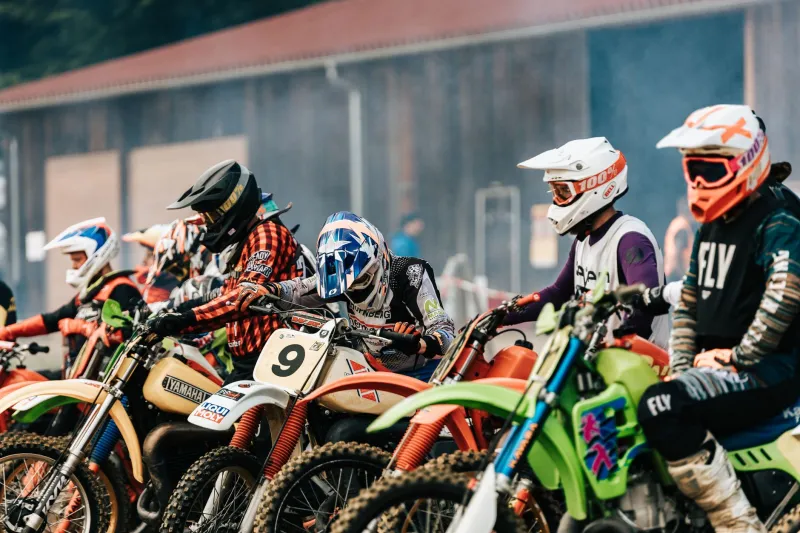
Gate drops have a habit of making good riders look average. You spend all winter working on corner speed, then the board goes sideways and you are suddenly third-row material before the first rut. The good news? You do not need a full track to fix that. A safe strip of private field, a marked-out garden practice area or a quiet private lane with permission can teach your body the first ten metres — and that is where most club-race places are won and lost.
This is not about turning your back garden into a supercross track. It is about building a habit. Twenty focused minutes, repeated through the 2026 off-season, will do more for your starts than a dozen vague race-day attempts.
Why the first ten metres deserve their own practice
Most riders practise starts by doing starts. They roll up to the gate, rev the bike, drop the clutch, get a bit sideways, then ride a full lap and forget the whole thing. That is not training; that is hoping with extra noise.
A holeshot is a sequence: reaction, body position, clutch release, throttle opening and weight transfer. Break it into pieces and you can train each one in a short space. You do not need a 20-minute lap. You need a start line, a marker at 15 to 20 metres, and enough self-control to stop before you get bored and sloppy.
Find a patch that works — and keep it legal
First rule: permission. Use private land you own or have explicit permission to ride on. Do not use public footpaths, bridleways, council land or public roads. A quiet lane might sound romantic, but unless it is private and legal for you to use, leave it alone. The last thing UK motocross needs is another access problem.
Look for flat, firm ground with a clear run-off. Wet grass is fine for body position work but will lie to you about grip. A hard-packed strip or a grassy field that drains well is better. Check for hidden holes, glass, fence wire and rabbits' burrows. Keep noise sensible, tell the neighbours, and do not leave tyre marks across someone's prize lawn.
Mark a start line with two cones or a stick. Put a marker 15 metres out, then 20. That is your practice lane. You are training the launch, not the lap.
Build a pretend gate
You can practise without a real gate, but you cannot practise without a routine. Use a helper with a stick, a board or a rolled-up jacket. Randomise the drop. If you know when it is coming, you are training anticipation, not reaction.
Stand in the same position every time. Hands where they will be on race day, goggles down, elbows up, feet on the pegs. Do the same breathing pattern. Some riders count; some watch the helper's hand. Pick one cue and stick with it. Consistency is the whole point.
Body position: chin over the crossbar
On the gate, sit forward with your chest low and your chin over or near the crossbar. Elbows up, knees gripping the tank, weight centred so the front end stays planted. If you sit back like you are waiting for a bus, the front will go light and you will spend the first five metres steering with hope.
When the gate drops, drive your hips forward and keep your chest low. Do not stand up straight. Let the bike push underneath you while you stay compact. Your arms should be bent and ready, not locked out. Think aggressive but quiet — no wasted movement.
Clutch and throttle: smooth is quicker than savage
Two-strokes and four-strokes feel different, but the principle is the same: consistent revs, controlled clutch release, then feed the power. Set your clutch free play before you start. Check your idle. A bike that stalls or creeps makes every start a lottery.
Hold a steady throttle before the drop. On the drop, release the clutch smoothly but quickly — dump it and you either wheelie, spin or stall. You want the rear tyre biting, not painting black lines across the field. If the front lifts, do not chop the throttle; stay over the front and let it come down.
Practise with one gear and one throttle position for ten reps. Change one thing at a time. If you change gear, throttle and body position together, you will learn nothing except how to make dust.
Four drills that fit in a short strip
- Body-only starts: no revs, no clutch dump. Just practise the forward move from gate position to first metre.
- Random drops: helper varies the wait from two to eight seconds. No guessing.
- Clutch-control reps: ride the clutch out from a standstill five times, focusing on a clean bite point.
- Filmed starts: prop a phone safely behind you and film from the side. You will see the sit-back and the early stand-up that you swear you are not doing.
Stop each drill while you still feel fresh. Tired starts teach bad habits.
The mistakes that cost you places
Looking down at the front tyre. Sitting too far back. Dumping the clutch because you are excited. Rolling off the throttle the second the front lifts. Changing your routine every time. Practising with a dirty air filter and a slack chain, then wondering why race day feels different. And the big one: doing twenty starts in a row until your technique turns to mush.
A 20-minute off-season session
Warm the bike, check the chain, tyres and clutch. Spend five minutes on body position, five on clutch release, five on random gate drops, and five on full starts with a stop at 20 metres. Note one thing that felt better. Then pack up. Do it once or twice a week through the colder months and keep it separate from your fitness riding.
Take the same routine to the gate
On race day, walk the first corner. Know your gate. Use the same breathing, the same hand position and the same forward move you practised in the field. If the start goes wrong, do not try to win it back in one corner. The first metre matters, but the race is still long.
Starts are not a mystery. They are a habit. Build it in the mud, in the wind, in a short strip of field — and by the time the 2026 season gets busy, the gate drop will feel like somewhere you have already been.